
The Jinshanling Great Wall — whose Chinese name “金山岭长城 (Jīnshānlǐng Chángchéng)” translates as “Gold Mountain Ridge Great Wall” — is one of the most historically significant and visually striking sections of the Great Wall of China. Stretching across the rugged mountains of the Yanshan range, at the junction of Hebei Province’s Luanping County and the Miyun District of Beijing, Jinshanling combines architectural sophistication, strategic military design, and natural beauty, offering a rare glimpse into the military, cultural, and social history of China over the centuries.
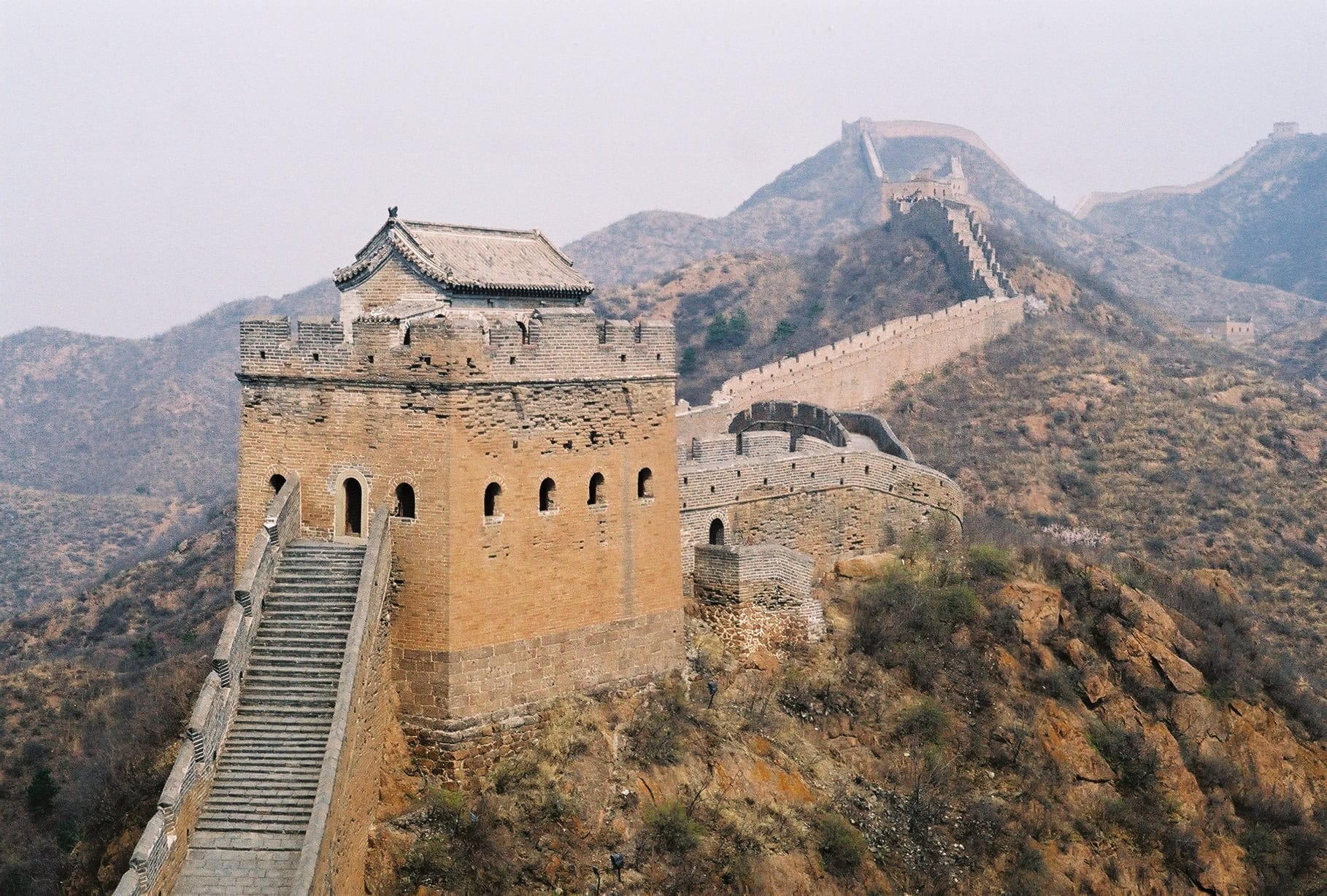 Panoramic view of Jinshanling Great Wall winding across the mountain ridges.
Early Origins — Pre‑Ming Foundations
Archaeological evidence indicates that the Jinshanling ridge may have hosted defensive walls as far back as the Northern and Southern Dynasties (6th century). Early walls were primarily rammed earth structures, relatively rudimentary but strategically located to guard mountain passes. Over the centuries, these early fortifications were repaired, expanded, or abandoned by successive dynasties in response to changing military needs.
Despite the antiquity of these early structures, most of what visitors see today originates from the Ming dynasty, when large-scale rebuilding brought the Wall to a durable stone-and-brick construction capable of withstanding both time and invasion.
Rebirth under the Early Ming: 1368 Onwards
After the founding of the Ming Dynasty (1368–1644), the northern frontiers required strong fortifications to protect the capital and surrounding regions. General Xu Da, a prominent Ming military leader, oversaw the reconstruction of the Jinshanling segment. The wall at Jinshanling stretches approximately 10.5 kilometers, featuring stone and brick construction designed to adapt to the rugged terrain.
 Jinshanling Wall climbing the ridges, blending natural landscapes with military engineering.
The Ming-era rebuilding replaced earlier earthen walls with sturdy stonework and reinforced structures capable of withstanding cavalry attacks, erosion, and harsh mountain weather.
Major Renovations under Qi Jiguang (1567 onwards)
In 1567, the legendary Ming general Qi Jiguang led extensive renovations of Jinshanling, implementing strategic improvements that transformed the section into a model of military architecture. Under his supervision:
- Watchtowers were more densely spaced to enable overlapping surveillance.
- Beacon towers were constructed for rapid communication using smoke signals.
- Parapets and barrier walls were strengthened to resist cavalry and infantry attacks.
- Defensive layouts were optimized for mountain terrain, integrating natural ridges, valleys, and cliffs.
The Jinshanling segment ultimately contained 5 main passes, 67 watchtowers, and multiple beacon platforms, making it one of the most formidable stretches of the Great Wall.
A Ming-era watchtower at Jinshanling showing arrow slits and defensive brickwork.
Each tower had specific functions: some served as storage for weapons and provisions, others housed soldiers or acted as observation posts. Some towers had multiple stories with internal rooms for resting, planning, and guarding, reflecting the sophistication of Ming-era military engineering.
Architectural Features and Engineering
Jinshanling Great Wall is not only a defensive structure but also a masterpiece of ancient Chinese engineering. Key architectural features include:
- Stone and brick construction: Large bricks, each weighing up to 12 kg, interlocked precisely for stability.
- Diverse tower designs: Single-story, double-story, square, and octagonal towers to fit the landscape and strategic needs.
- Parapets and crenellations: Designed for archers and soldiers to defend the Wall efficiently.
- Barrier walls: Curved walls that slowed enemy cavalry and controlled access points.
- Inscribed bricks: Many bricks carry inscriptions, including the year of manufacture and names of artisans.
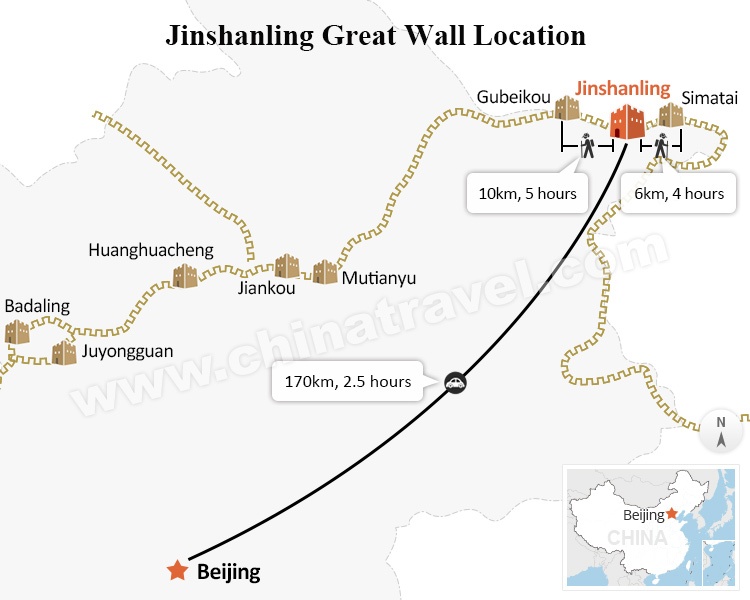 Map showing the location and layout of Jinshanling Great Wall.
The meticulous layout ensured “passes linked, watchtowers facing each other, layered fortifications, overlapping fields of fire, and beacon signaling”, making Jinshanling both visually impressive and highly functional in military terms.
Strategic Importance
Geographically, Jinshanling guards critical mountain passes connecting northern plains to the heartland of the Ming empire. Its elevation and placement allowed early detection of enemy movement, giving defenders ample time to prepare or signal other fortifications. The Wall’s layout — weaving across peaks, cliffs, and valleys — took full advantage of natural topography to maximize defensive capability.
Throughout the Ming dynasty, Jinshanling, along with neighboring sections like Simatai and Gubeikou, formed a key component of a northern defense network. Historical records indicate that its design effectively deterred raiders and incursions, illustrating the foresight of Ming military planning.
Watchtowers overlooking valleys, demonstrating strategic placement.
Jinshanling as a Cultural and Historical Heritage
Beyond its military function, Jinshanling reflects the cultural and social history of China. Construction required coordinated labor, architectural skill, and resource mobilization, often involving soldiers, artisans, and local communities. The Wall’s inscriptions and remaining architectural details provide insights into Ming-era logistics, craftsmanship, and governance.
As a preserved segment, Jinshanling offers historians and archaeologists a rare opportunity to study Ming dynasty fortification techniques, including mortar composition, brick-making technology, and tower design strategies.
Natural Scenery and Tourism
Jinshanling is renowned for its breathtaking mountain landscapes, offering sweeping views of peaks, valleys, and distant ridges. Its partially restored sections provide safe access for tourists, while the “wild” sections offer adventure for hikers seeking a more authentic experience.
- Spring: Lush green mountains and blooming wildflowers.
- Summer: Clear skies with panoramic vistas.
- Autumn: Vibrant red and gold foliage, creating stunning photographic opportunities.
- Winter: Snow-dusted towers and walls create a dramatic, serene atmosphere.
Hikers exploring Jinshanling Wall, enjoying historical architecture and scenic views.
Many visitors now trek along Jinshanling to experience both the history and natural beauty, capturing photographs of watchtowers, steep cliffs, and ancient stonework that blend harmoniously with surrounding mountains.
Conservation and Preservation
Jinshanling has benefitted from careful restoration and preservation efforts in recent decades. Unlike many Great Wall sections that have deteriorated, Jinshanling’s stone construction, combined with attention to historical accuracy in restoration, ensures that it remains a vivid testament to Ming military architecture.
Conservation projects aim to maintain both the “restored” and “wild” characteristics, balancing historical integrity with visitor safety. Preservation efforts also focus on:
- Preventing erosion and collapse.
- Documenting inscriptions and architectural details.
- Managing visitor impact through controlled hiking routes.
Why Jinshanling Still Matters
Today, Jinshanling is more than a tourist destination; it is a living museum of ancient Chinese military strategy, architecture, and social organization. Visitors can walk along the ridges, explore watchtowers, and imagine the lives of soldiers who once defended these peaks.
Its layered fortifications, historical inscriptions, and scenic vistas create an immersive experience that is educational, adventurous, and deeply reflective of China’s heritage.
Conclusion
Jinshanling Great Wall stands as a monument to centuries of human ingenuity, labor, and strategic vision. From early fortifications to the Ming dynasty’s sophisticated constructions, from Qi Jiguang’s military genius to modern preservation efforts, Jinshanling embodies the enduring legacy of the Great Wall. For hikers, historians, photographers, and travelers, it offers an unforgettable journey through time, history, and the mountains of northern China.


