
Full Article: History, Architecture & Cultural Significance of Lama Temple
Origins: From Prince’s Mansion to Royal Palace
The origins of Lama Temple trace back to 1694, during the reign of the Kangxi Emperor of the Qing dynasty. On the site previously occupied by Ming-dynasty official residences for eunuchs, a building was constructed which later became the residence granted to his fourth son, Yinzhen.
In 1709, Yinzhen was elevated to the rank of First-Rank Prince (“Prince Yong of the First Rank”), and the building became known as the “Residence of Prince Yong.” He moved in around 1703.
A significant turn came in 1722, when Yinzhen ascended the throne as Yongzheng Emperor. His former residence was upgraded to a royal palace, given the name Yonghe Palace (雍和宫), literally “Palace of Harmony and Peace.”
After Yongzheng’s death in 1735, his coffin was temporarily placed here — a mark of its royal significance. During this period, the main halls’ original turquoise (or green-glazed) tiles were replaced with yellow glazed tiles, a color previously reserved exclusively for the emperor — officially elevating the palace’s status.
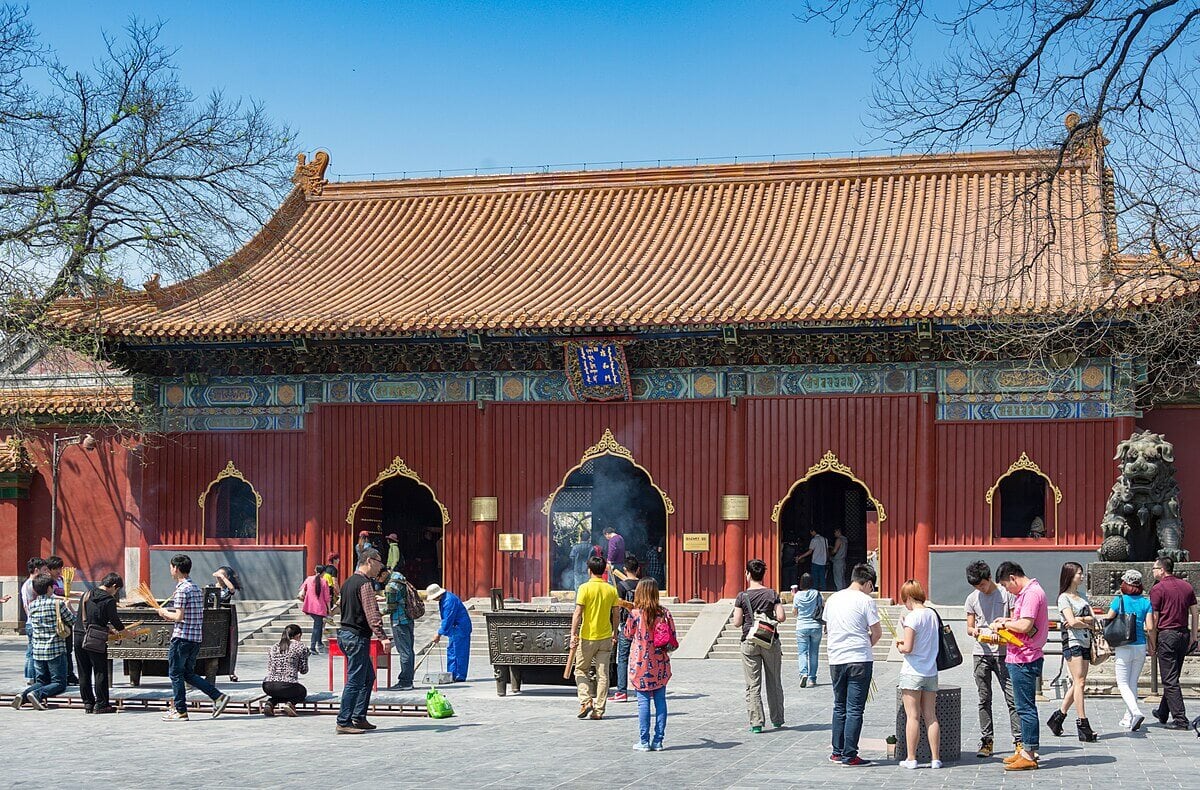
Hence, Lama Temple’s early centuries reflect its identity as a royal residence and court palace, sharing architectural grandeur with imperial standards (yellow roofs, red walls), comparable to but smaller than the Forbidden City.
Transformation: From Palace to Lama Temple
In 1744, during the reign of Qianlong Emperor, Yonghe Palace was officially converted into a Tibetan Buddhist lamasery. This marked the beginning of its long history as a major religious and cultural center.
This conversion was not merely religious: it held deep political and cultural meaning. The Qing court used the temple as a national center to manage Tibetan Buddhist affairs across the empire — integrating Mongolian, Tibetan, Manchu and Han ethnicities under unified imperial oversight.
As part of this transformation, although the Han-style layout and palace-like architecture were preserved, Tibetan Buddhist architectural elements and religious symbolism were introduced — symbolizing unity of ethnic and religious cultures under the Qing empire.
Hence, Lama Temple became a powerful emblem of ethnic/religious integration and political patronage of Tibetan Buddhism by the imperial court.
Architecture & Layout: A Fusion of Han and Tibetan Styles
Covering an area of about 66,400 square meters, Lama Temple stands as the largest and best-preserved Tibetan Buddhist monastery in Beijing. Its layout follows a central north–south axis, typical of Chinese palace/temple planning: three ornate archways and seven successive courtyards lead from the southern entrance all the way to the northern pavilion complex.
Along this axis lie the five main halls (from south to north):
- The Hall of Heavenly Kings (Tianwang Hall)
- The Hall of Harmony and Peace (Yonghe Hall) — the main hall
- The Hall of Everlasting Blessings (Yongyou Hall)
- The Hall of the Wheel of the Law (Falun Hall)
- The Pavilion of Ten Thousand Happinesses (Wanfuge Pavilion) at the rear
Flanking these halls are subsidiary buildings — lecture halls, monks’ quarters, storage buildings, and annexes — making the complex self-contained for religious, administrative and living functions typical of a major monastery.
What makes Lama Temple architecturally remarkable is the blend of Han (imperial palace) style and Tibetan Buddhist elements. The yellow-tiled roofs and red walls echo imperial aesthetics; meanwhile, some halls feature Tibetan-Buddhist iconography — gilded statues, Tibetan-style roof finials, Buddhist mandalas, and decorative motifs borrowed from Lhasa-style temples.
One dramatic example: the Falun Hall includes a cross-shaped plan, and its roof bears five gilded finials — a composition reminiscent of a Tibetan Buddhist mandala. This architectural fusion physically embodies centuries of cultural transmission — from Han court architecture to Tibetan Buddhist spiritual space — all in the heart of Beijing.
Spiritual Treasures: Buddhas, Artworks & Relics
Inside its halls, Lama Temple houses remarkable Buddhist statues, wood-carvings, thangkas, scriptures, and religious artifacts, many of which are considered masterpieces of Qing-era craftsmanship.
1. The Giant Sandalwood Maitreya Buddha
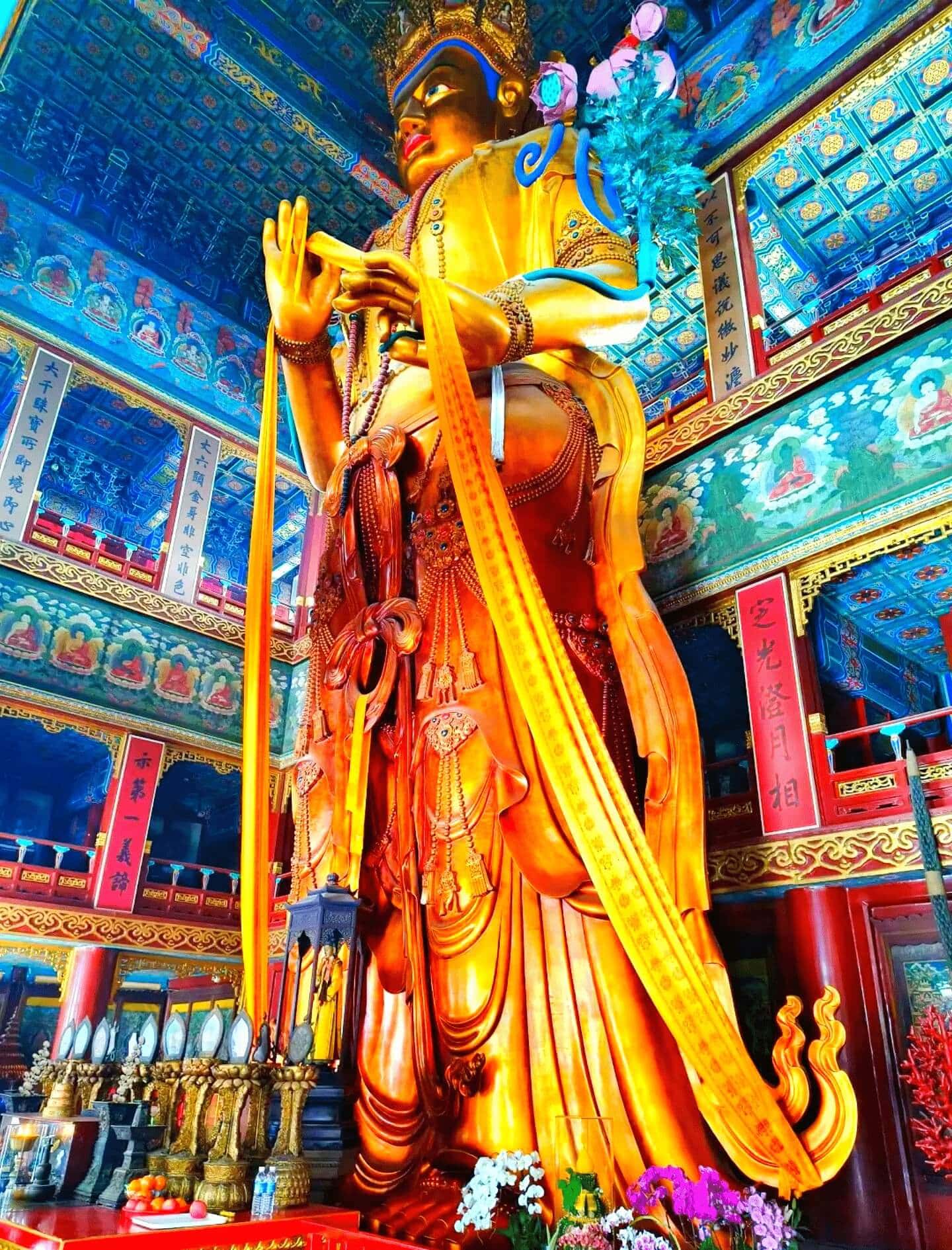
In the Wanfuge Pavilion stands the temple’s iconic treasure — a huge Maitreya (future Buddha) statue. Carved from a single 26-meter white sandalwood tree, the statue is 18 meters tall above ground (with another 8 meters underground for stability). This statue was a gift from the Seventh Dalai Lama to the Qing court. It is widely regarded as one of the greatest wood carvings in the temple — and one of the tallest single-piece wooden Buddha statues in the world.
2. The 500-Arhats Carving (Arhat Hill)
In the Falun Hall stands another masterpiece — a nearly 5-meter high wood carving of 500 Arhats (enlightened disciples), each in unique pose, carved in precious wood, metal, and painted detail. This stands alongside a 6.1-meter bronze statue of Tsongkhapa — founder of the Gelug (“Yellow Hat”) school of Tibetan Buddhism — placed on a lotus throne, symbolising the Dharma’s transmission under Qing patronage.
3. Halls of Buddhas of Three Ages & Healing Buddha
In the main hall (Hall of Harmony and Peace), three bronze statues represent the Buddhas of the Past, Present and Future — illustrating Buddhist cosmological beliefs of universal time and cyclic existence.
In Yongyou Hall (formerly private residence chambers), statues of Amitābha Buddha (Buddha of Infinite Light), Medicine Buddha (healing), and another Buddha symbolise blessings, health and spiritual refuge.
4. Multilingual Scriptures, Murals and Artifacts
Because the temple served as a centre for Tibetan Buddhism across ethnically diverse Qing empire — including Mongolian, Tibetan, Manchu and Han communities — many scriptures, inscriptions, thangkas and ritual items in multiple languages (Tibetan, Mongolian, Manchu, Chinese) are preserved here. This underscores the temple’s role not just religiously — but as a vehicle of cultural exchange and imperial unity.
Religion, Ethnic Harmony & Political Symbolism
Converting Yonghe Palace into a Tibetan Buddhist lamasery in 1744 was more than a religious act — it was a political and cultural statement. Lama Temple served as the national centre for Tibetan Buddhist administration. It housed monks from Tibet and Mongolia, oversaw matters of reincarnation, and managed Buddhist affairs — demonstrating political control, religious patronage, and ethnic integration.
The name “Yonghe” — Harmony and Peace — reflects the imperial aspiration for unity and stability across ethnic, regional, and religious divides. Lama Temple’s dual identity as former royal palace and Buddhist monastery symbolizes the convergence of imperial authority and spiritual inclusion. Today, the temple remains a living place of worship, with monks conducting ceremonies, and believers coming for prayers, incense offerings, blessings and meditation.
Modern Times: Preservation, Public Opening and Cultural Importance
After the fall of the Qing dynasty and through turbulent 20th-century Chinese history, Lama Temple survived political upheaval. It was declared a protected national cultural relic. In 1981, Lama Temple reopened to the public, and in 1983 it was designated a “national key Buddhist temple in Han area” — recognizing both its religious and cultural value.
Today, Lama Temple is simultaneously:
- A functioning lamasery, where religious rituals continue;
- A cultural heritage site, preserving centuries-old architecture, art, scriptures;
- A popular tourist attraction, drawing hundreds of thousands of domestic and international visitors yearly;
- A symbol of ethnic & religious harmony, representing historical integration and modern cultural identity in Beijing.
Visiting Lama Temple: What to See & Tips
What to See / Don’t Miss
- Sweeping yellow-roof red-wall architecture along the central axis.
- Giant Sandalwood Maitreya Buddha in Wanfuge.
- 500 Arhats carving + Tsongkhapa statue in Falun Hall.
- Three Buddhas hall + Medicine Buddha hall.
- Traditional Tibetan Buddhist artifacts — thangkas, multi-language scriptures, painted decorations.
Practical Info
- Opening hours: 09:00–17:00 (April–Oct) / 09:00–16:30 (Nov–Mar), last entry ~30 min before closing.
- Ticket: ~¥25 (subject to change).
- Recommended visit duration: 1.5–2.5 hours.
- Respect the religious environment: dress modestly, speak quietly, avoid disruption.
Why Lama Temple Matters — Historically and Today
- A Living Bridge Between Cultures: Fusion of Han imperial architecture and Tibetan Buddhist spiritual space.
- Religious Heritage & Continuity: Active monastery with ongoing rituals and worship.
- Art & Craftsmanship Legacy: Wooden Buddhas, bronze statues, carvings — Qing-era masterpieces.
- Symbol of Tolerance & Unity: Demonstrates coexistence of multiple ethnicities and traditions.
- Cultural & Tourist Landmark: A must-visit in Beijing for architecture, history, and spiritual ambiance.
Conclusion
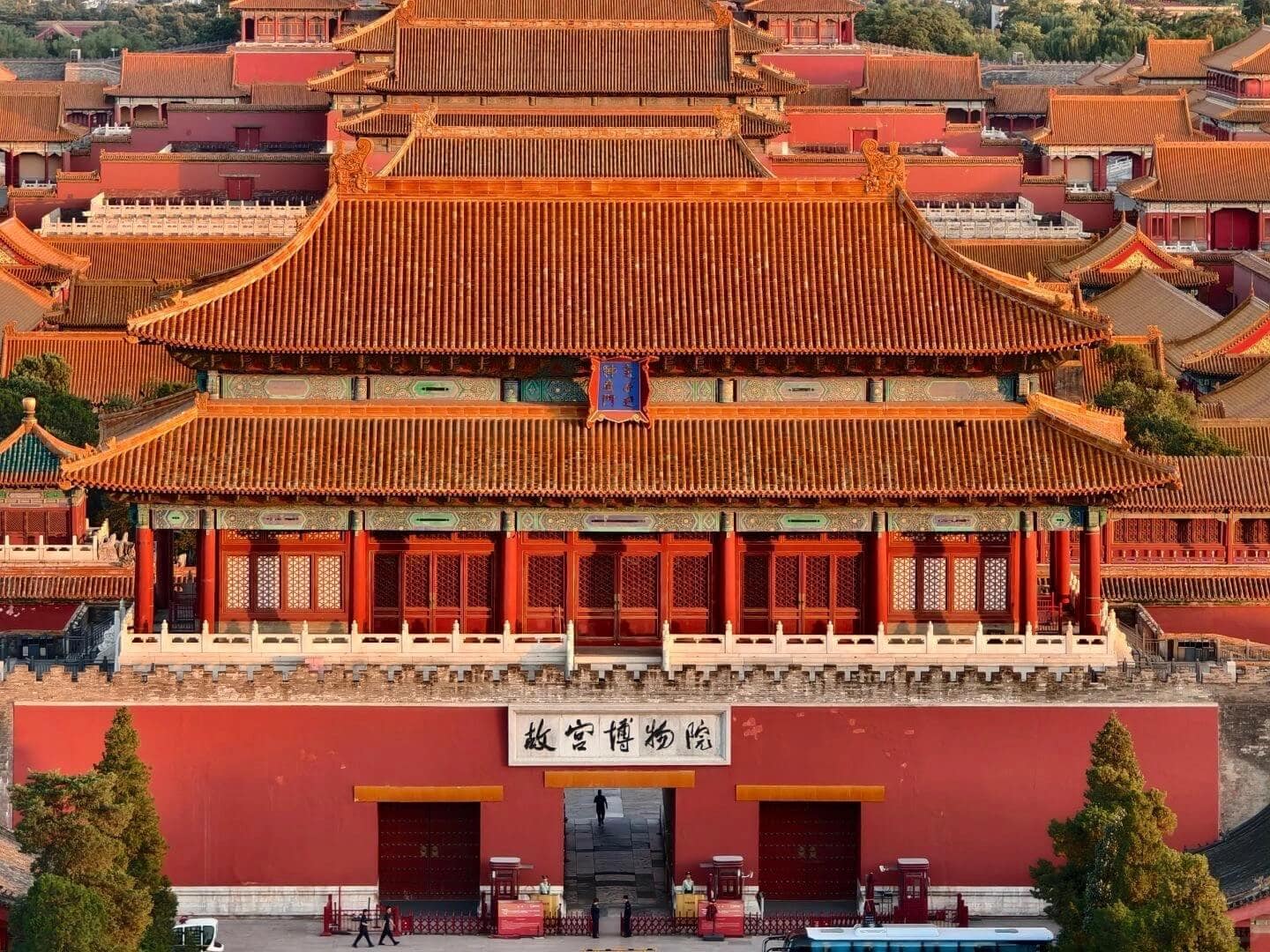
Lama Temple (Yonghe Gong) has lived multiple lives: prince’s residence, royal palace, and Tibetan Buddhist monastery. Its halls echo imperial history, its statues radiate spiritual serenity, and its architecture embodies cultural synthesis. Today it stands as a living temple, cultural heritage site, and a symbol of tradition, faith, ethnic unity, and religious diversity in Beijing — a place every visitor should experience.


